



Cybersecurity tools can spot suspicious activity. But an alert alone won’t stop a threat. What happens next can determine whether the issue is contained or allowed to spread.
That distinction is at the center of the MDR vs. EDR decision. Endpoint detection and response (EDR) monitors laptops, desktops, servers, and other endpoints for signs of malicious activity. Managed detection and response (MDR) combines security technology with professionals who monitor, investigate, and respond to threats.
For businesses with an experienced security team that can review alerts and take action at any hour, EDR may provide the capabilities they need. For organizations without that internal coverage, MDR is often the more practical choice. It gives the business access to both detection tools and the people needed to use them.
Key Takeaways
- EDR monitors endpoint activity and helps detect, investigate, and contain threats.
- MDR is a managed service that adds ongoing monitoring, threat investigation, and response by security professionals.
- EDR still requires someone to review alerts, separate real threats from false positives, and act.
- The right choice depends less on company size than on internal security expertise, availability, and the scope of protection required.
What Is EDR?
Every laptop, desktop, and server connected to your organization can become an entry point for an attacker. Antivirus software is designed largely to identify known malicious files. EDR goes further by continuously observing what happens on an endpoint and looking for behavior that may indicate an attack.
For example, EDR may notice an unfamiliar process trying to encrypt many files or a device communicating with a malicious destination. It also collects information that can help a security professional understand what happened and what else may have been affected.
Depending on its configuration, EDR can also isolate a device, stop a process, or quarantine a file. The National Institute of Standards and Technology describes EDR as technology that continuously monitors endpoints to detect, analyze, and respond to cyber threats.
Those capabilities are valuable, but EDR doesn’t eliminate the need for human attention. It generates alerts and supplies the information and controls needed for an investigation. Someone still has to decide whether an alert represents a real attack, how serious it is, and what should happen next.
What Is MDR?
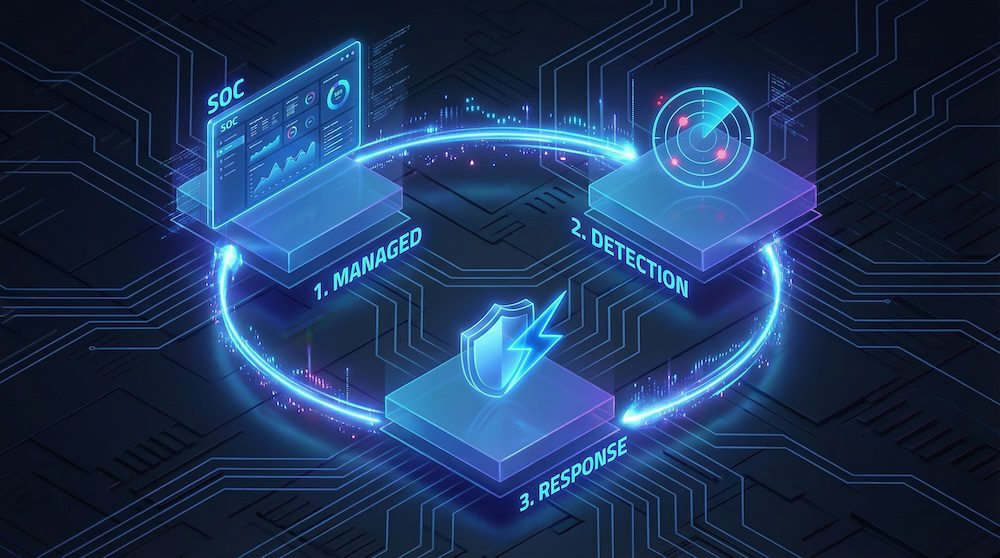
MDR adds a managed security service around detection and response technology. A provider’s security professionals monitor the client’s environment, investigate suspicious behavior, and respond when they confirm a threat.
EDR is often an important part of an MDR service, but it may not be the only part. Some MDR providers also collect and analyze information from identity systems, email, cloud applications, networks, and other security tools. This broader view can help connect activity that appears unrelated when each system is examined on its own.
Suppose an account signs in from an unusual location, creates an email-forwarding rule, and downloads files to an unfamiliar device. An endpoint alert may show only part of that sequence. An MDR team monitoring several systems may recognize the full pattern.
Response may include isolating a device, disabling an account, blocking a malicious connection, or contacting the business with specific remediation steps. The provider should spell out exactly what it monitors and what it is authorized to do before service begins.
What Is the Main Difference Between MDR and EDR?
The simplest difference is that EDR is a technology, while MDR is a service delivered by people using technology.
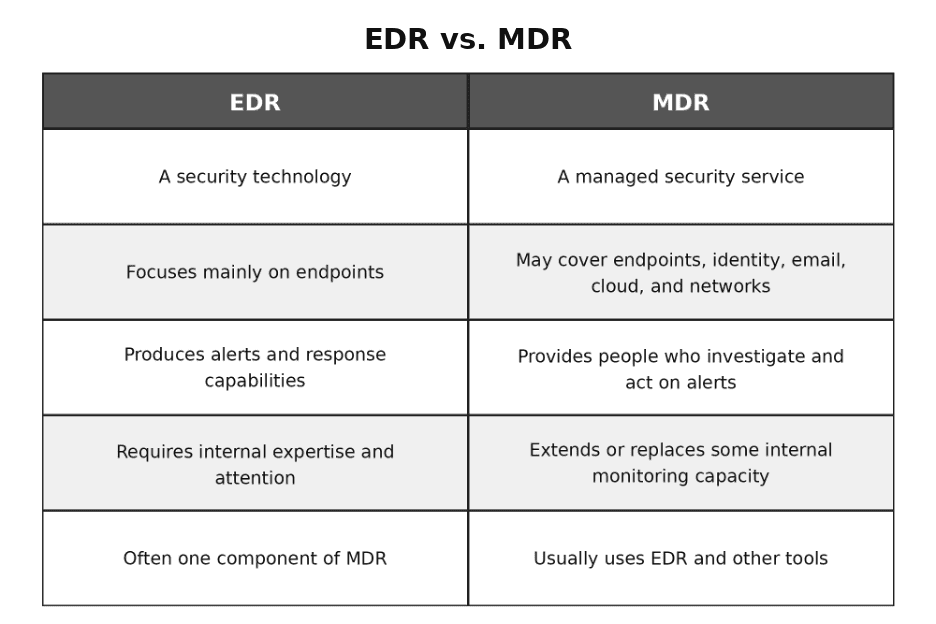
The distinction matters because an alert is not the same as a response. Even a well-configured tool can produce false positives, low-priority findings, and alerts that need additional context. If nobody is watching, or if alerts sit until the next business day, the organization may have strong detection technology without timely protection.
This is particularly important for attacks that can spread quickly. Verizon’s 2025 Data Breach Investigations Report found that ransomware appeared in 44% of the breaches it reviewed. In its small and midsize business analysis, ransomware was involved in 88% of breaches. Someone must be ready to contain it.
When Can EDR Be the Right Choice?
EDR can make sense when a business already has people with the expertise and time to manage it properly.
That requires clearly assigned responsibility for reviewing alerts, investigating activity, maintaining detection policies, and taking action. It also requires a plan for nights, weekends, and vacations.
EDR may be a good fit if your organization:
- Has an internal security team or security operations center
- Can consistently monitor alerts during the hours your risk requires
- Has the expertise to investigate endpoint activity
- Has documented response procedures and authority to isolate devices or accounts
The software license is only one part of EDR’s cost. Staffing, training, configuration, maintenance, and after-hours coverage also need to be considered.
When Is MDR a Better Fit?
MDR is often better suited to a small or midsize business that needs continuous detection and response but cannot staff a security team around the clock.
MDR can also support an internal IT department that understands the company’s systems but does not specialize in threat investigation. The provider adds security expertise and coverage, while internal IT supplies business context and handles the responsibilities that remain in-house.
MDR may be the stronger choice if your business:
- Does not have dedicated security analysts
- Can’t provide reliable monitoring outside normal business hours
- Receives more alerts than its internal team can investigate
- Needs help distinguishing real threats from routine activity across several systems
- Needs clearer, faster guidance when suspicious activity is confirmed
MDR does not transfer every security responsibility to the provider. The business still needs sound access controls, patching, backups, security awareness training, and an incident response plan.
What Should You Ask an MDR Provider?
MDR services are not standardized. Two providers may use the same term while offering very different coverage and response.
Start by asking what the service monitors. Does it cover only endpoints, or also productivity suites, cloud services, identity systems, firewalls, and network activity? Confirm which devices are included.
Then examine the response process. Is the service staffed 24/7, or are alerts merely collected around the clock? How quickly are serious alerts investigated? Can the provider isolate a device or disable an account immediately, or must it wait for approval?
Other useful questions include:
- What actions will your team take during a confirmed attack?
- Who is responsible for removing the threat and returning systems to normal?
- What reports will we receive, and will they explain outcomes in business terms?
- What support is provided after the immediate threat has been contained?
Pay close attention to the boundary between containment and remediation. A provider may stop malicious activity but leave cleanup, recovery, and the underlying vulnerability to the client.
How Do You Decide Between MDR and EDR?
Begin with an honest assessment. Who reviews security alerts today? How quickly can that person investigate? Who covers after hours? Does the team know how to trace an attack across several systems? Who has authority to contain it?
If your business can answer those questions confidently, EDR may be appropriate. If responsibility is unclear or coverage stops at the end of the workday, buying another tool may not solve the underlying problem. MDR may close the larger gap.
Compare costs on the same basis. EDR costs include the people, training, administration, and coverage required to use it. For MDR, examine which systems and response services are included and whether remediation carries additional fees.
The answer may also be both. Many MDR services include EDR technology and managed monitoring together.
Strengthen Detection and Response With GoodSuite
The right solution should give your business a clear way to identify suspicious activity, understand it, and respond before the damage spreads.
GoodSuite provides 24/7 cybersecurity monitoring, early threat detection, and expert response. Our team can review your security posture and help determine what level of protection fits your systems, risks, and resources.
Start a conversation with GoodSuite about how your business currently detects and responds to cyber threats.
Frequently Asked Questions
Does cyber insurance require EDR or MDR?
Requirements vary by insurer and policy. Some applications ask specifically about EDR, 24/7 monitoring, or managed response, while others focus more broadly on security controls. Review the exact wording with your broker and confirm that the solution, device coverage, and monitoring arrangement match what is represented on the application.
Can MDR help with regulatory compliance?
MDR may support requirements related to continuous monitoring, logging, detection, and incident response, but it does not make a business compliant by itself. Ask whether the provider supplies reports and evidence suited to the frameworks or regulations that apply to your organization, and clarify which compliance responsibilities remain internal.
How long does MDR implementation take?
Timing depends on the number of devices, systems being monitored, existing integrations, and the complexity of the environment. A responsible rollout also includes defining escalation paths, response authority, and communication procedures. Ask for a plan that explains when each source will be connected and when monitoring will begin.