
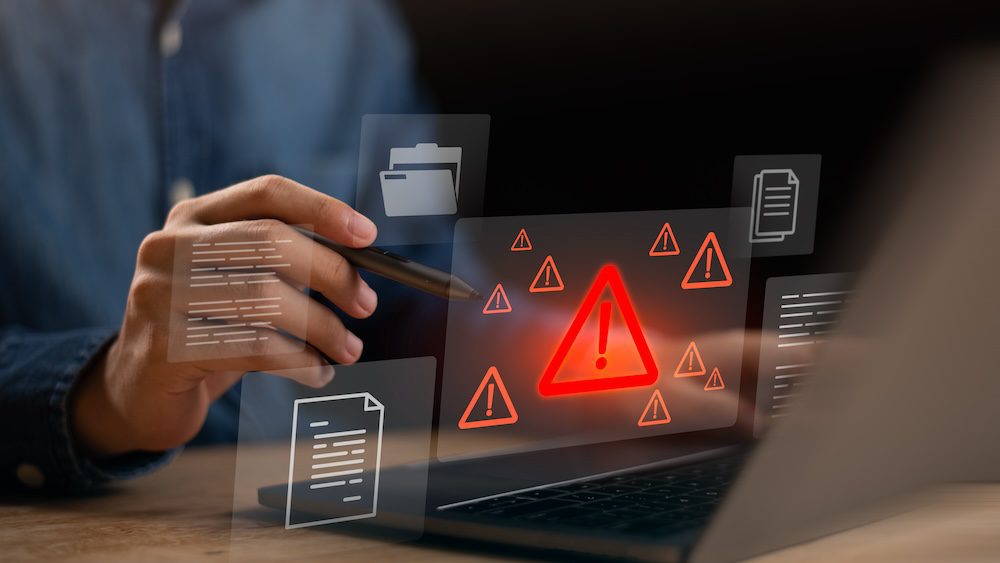
Your printer runs out of toner at the worst possible time. A cyberattack slips past your defenses because it looked like normal user behavior. Your backup system fails, and no one realizes until you need to restore something.
These are the kind of disruptions that cost businesses time, money, and trust, often because problems go unnoticed until they’ve already caused damage.

The good news is that many of these issues can be caught early. The reason has less to do with new technology and more to do with how the systems you already rely on have become smarter.
Artificial intelligence is embedded in the services that you use to keep your office running: monitoring activity, analyzing patterns, and flagging issues that would be nearly impossible to catch manually. For most businesses, AI is most valuable when it works invisibly, strengthening the systems you already depend on.
What AI Actually Does in Managed Services
AI analyzes the data your systems generate every day and looks for patterns that indicate something is off.
A device behaving differently than usual. A user accessing systems at 2 a.m. A backup that completes, but with an unexpected file size. These are the kinds of subtle changes that humans miss, especially when they happen gradually over weeks.
The shift this creates is meaningful: instead of reacting after something breaks, you can address issues earlier. Instead of relying on assumptions, you gain visibility into how your systems behave. Across Managed Print, IT, cybersecurity, backup, and communications, AI acts as a steady layer of oversight that helps prevent disruptions before they reach your team.
1. Managed Print: Predictability Instead of Panic
Printers are still essential in many offices. They’re also one of the most common sources of frustration.
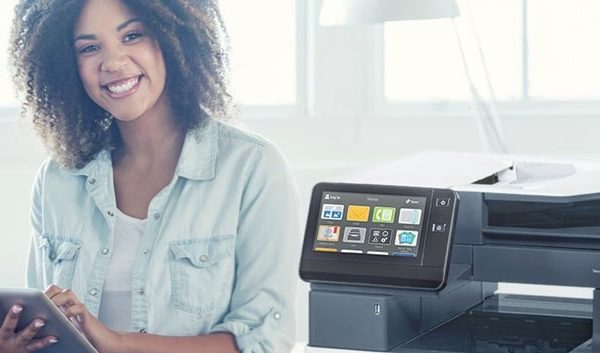
AI brings order to this chaos by continuously monitoring print volumes, device health, and usage trends across your entire fleet. Instead of waiting for a printer to fail or for staff to submit tickets, the system anticipates when service or supplies will be needed. Maintenance and replenishment happen before problems disrupt workflows.
AI also catches unusual printing behavior. Sudden spikes in output, repeated failed jobs, or printing outside normal business hours can indicate misuse or security concerns. By flagging these patterns automatically, you gain better control over your print environment without adding manual oversight.
The result? Employees spend less time troubleshooting devices and IT teams get better insight into how resources are being used.

2. Managed IT: Preventing Problems Before Users Notice
In traditional IT support, issues get addressed after users experience them. Systems slow down, applications crash, devices fail; then tickets get submitted.
AI helps flip this dynamic.
It continuously monitors the health and performance of servers, workstations, and networks. It can spot patterns like increasing memory usage, storage filling faster than expected, or systems responding more slowly over time. AI identifies these trends early, allowing IT teams to step in before users notice anything is wrong.
AI also streamlines support workflows. Routine issues get categorized and prioritized automatically, ensuring faster response times and more consistent service. This frees IT professionals to focus on complex tasks rather than sorting through repetitive requests.
The impact shows up in fewer interruptions and a more stable technology environment. AI doesn’t replace IT expertise; it strengthens it by providing better information sooner.
3. Cybersecurity: Catching Threats That Look Legitimate
Modern cyberattacks are designed to mimic legitimate user behavior, making them nearly impossible to detect with traditional, rule-based tools.
AI-powered cybersecurity focuses on behavior rather than static threat definitions. These systems learn what normal activity looks like in your specific environment, such as login habits, file access patterns, network traffic, and device behavior.
When activity deviates from that baseline, AI triggers alerts or takes action in real time. An unusual login attempt gets flagged. A compromised device gets isolated. Suspicious access gets blocked before data is exposed.
This approach is especially valuable for businesses without dedicated security teams. AI provides continuous monitoring that would be nearly impossible to replicate manually. It reduces the time between detection and response, which can make the difference between a contained incident and a costly breach.
4. Backup and Disaster Recovery: Confidence When It Matters Most
Backups are one of those systems businesses rarely think about until something goes wrong. Unfortunately, that’s also when problems with backup processes are often discovered.
AI ensures your backup and disaster recovery systems are working long before a crisis occurs.
By monitoring backup activity continuously, AI detects incomplete backups, unexpected changes in data size, or irregular patterns that could signal ransomware or corruption. Instead of assuming backups are working, you receive confirmation and alerts when something isn’t right.
AI also supports smarter recovery planning. Since not every system has the same level of importance, AI-assisted tools help prioritize which systems should be restored first based on business impact. This reduces downtime and confusion during high-pressure situations.
This added oversight gives you confidence. When recovery plans are needed, there’s less guesswork and more certainty that systems can be restored effectively.
5. Managed VoIP: Communication Without the Frustration
Call quality issues are difficult to diagnose and frustrating for users. AI removes much of that friction in Managed VoIP environments.
It monitors call performance, network conditions, and usage patterns in real time. AI can detect latency, packet loss, and congestion before they impact call quality.
Beyond troubleshooting, AI provides insight into how phone systems are used. You can better understand call volumes, peak usage times, and overall trends without manually analyzing reports.
The benefit is a more reliable communication experience with fewer support requests. Employees spend less time dealing with dropped calls or poor audio. IT teams gain better visibility into system performance.

Why Integration Matters
Each of these services benefits from AI individually. However, the real value emerges when they’re supported as part of a connected ecosystem.
Issues rarely exist in isolation. A security incident may impact system performance, network congestion can affect call quality, and unusual user behavior may surface across multiple platforms at once.
When services are managed together, AI can correlate activity across systems and provide a clearer picture of what’s happening. This integrated approach leads to faster, more accurate responses. Instead of treating symptoms, teams can address root causes.
For businesses, this means fewer disruptions and more confidence in your technology environment.
Choosing a Managed Services provider that integrates AI across print, IT, security, backup, and communications helps ensure these systems work together rather than competing for attention.
The Real Opportunity
One of the biggest misconceptions about AI is that it requires businesses to overhaul how they operate. In reality, the most effective use of AI often requires very little from you.
By working with a provider like GoodSuite that already embeds AI into its Managed Services, you benefit from smarter monitoring, faster response times, and improved reliability without adding new tools or workflows.
AI should simplify technology, not add another layer to manage. When implemented thoughtfully, it helps you avoid problems, respond quickly when issues arise, and keep day-to-day operations running smoothly.
The future of AI in your office isn’t about a dramatic transformation. It’s about making familiar systems work better, with fewer interruptions and more peace of mind.
Is your current technology setup working as hard as it could be?
Relying on reactive support or siloed services can make it harder to catch issues early. Give us a call and let’s talk about how integrated, AI-powered Managed Services can support and strengthen your existing environment.
About GoodSuite
GoodSuite is a boutique Managed Services provider that helps businesses simplify, secure, and support their technology environment. Their services include Managed IT, Cybersecurity, Cloud Solutions, Backup and Disaster Recovery, Managed Print Services, and VoIP phone systems, along with office technology such as copiers and printers. Based in California, GoodSuite supports organizations across Southern California and throughout the United States with proactive service and strategic technology guidance.